> ## Documentation Index
> Fetch the complete documentation index at: https://docs.aihubmix.com/llms.txt
> Use this file to discover all available pages before exploring further.
# Claude Opus 4.7 New Parameters Guide
 > This article covers two key changes to reasoning control in [Claude Opus 4.7](https://aihubmix.com/model/claude-opus-4-7), along with complete usage instructions for both the **AIHubmix** native API and the **Chat** unified interface. See also: [Anthropic official announcement](https://www.anthropic.com/news/claude-opus-4-7) and [model change log](https://platform.claude.com/docs/en/about-claude/models/whats-new-claude-4-7).
## 1. New Reasoning Control Features
### ✦ New `xhigh` Reasoning Effort Level
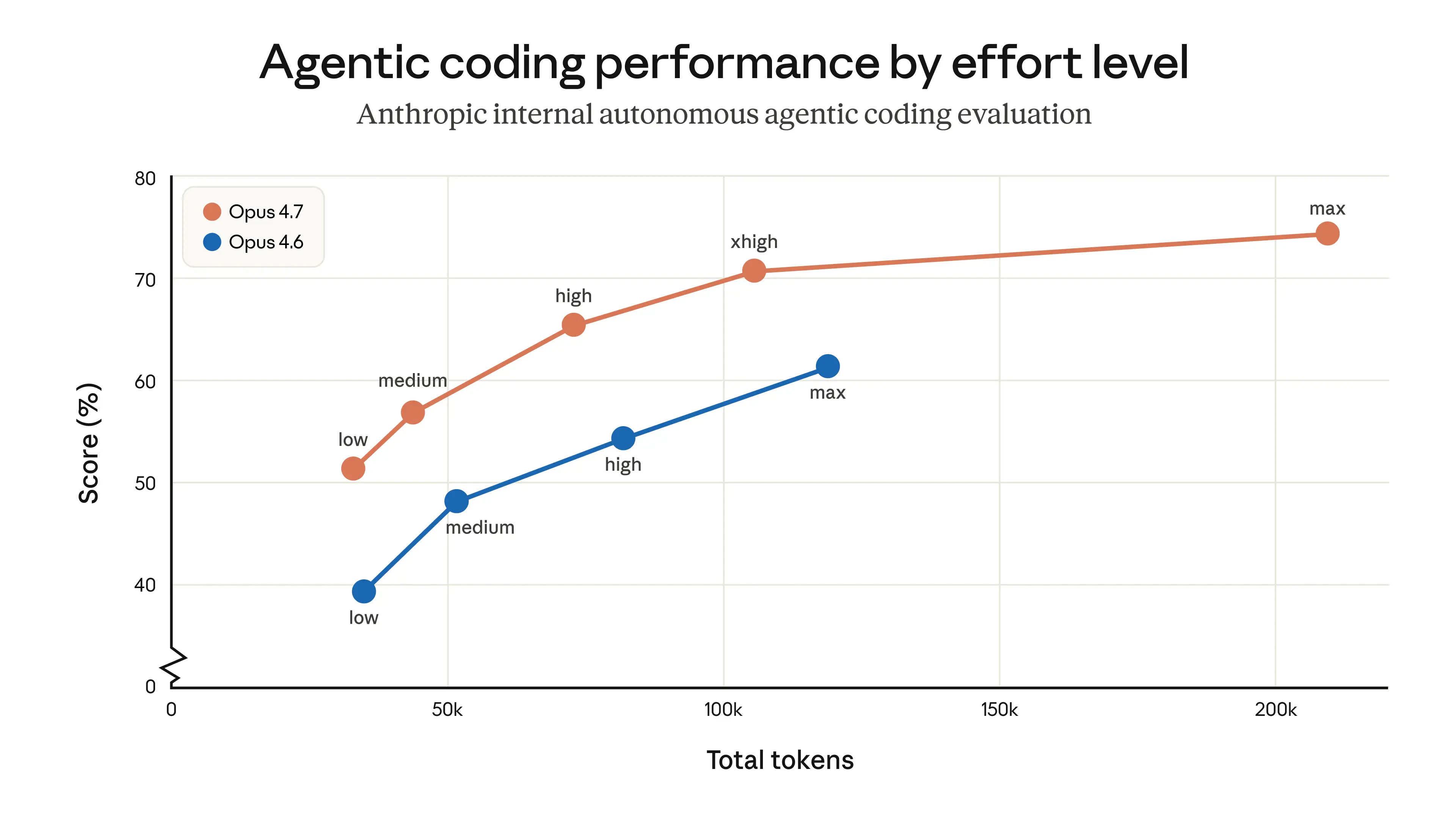
The new `xhigh` level sits between `high` and `max`, designed specifically for **coding and agentic tasks**, striking a better balance between capability and efficiency.
```text theme={null}
low ── medium ── high ── xhigh ★NEW ── max
```
### ✦ Thinking Content Hidden by Default
In streaming responses, the thinking process is **no longer shown by default**. To receive a reasoning summary, explicitly pass the `display` field in your request:
| **display value** | **Opus 4.7** | **Opus 4.6** | **Behavior** |
| :---------------- | :---------------- | :----------- | :------------------------------ |
| "omitted" | **Default** | Non-default | Thinking block content is empty |
| "summarized" | Must set manually | **Default** | Returns thinking summary text |
```text theme={null}
"reasoning": {
"effort": "xhigh",
"display": "summarized"
}
```
> **Figure**: Opus 4.7 new xhigh level — Agentic coding performance comparison (Source: Anthropic official)
> This article covers two key changes to reasoning control in [Claude Opus 4.7](https://aihubmix.com/model/claude-opus-4-7), along with complete usage instructions for both the **AIHubmix** native API and the **Chat** unified interface. See also: [Anthropic official announcement](https://www.anthropic.com/news/claude-opus-4-7) and [model change log](https://platform.claude.com/docs/en/about-claude/models/whats-new-claude-4-7).
## 1. New Reasoning Control Features
### ✦ New `xhigh` Reasoning Effort Level
The new `xhigh` level sits between `high` and `max`, designed specifically for **coding and agentic tasks**, striking a better balance between capability and efficiency.
```text theme={null}
low ── medium ── high ── xhigh ★NEW ── max
```
### ✦ Thinking Content Hidden by Default
In streaming responses, the thinking process is **no longer shown by default**. To receive a reasoning summary, explicitly pass the `display` field in your request:
| **display value** | **Opus 4.7** | **Opus 4.6** | **Behavior** |
| :---------------- | :---------------- | :----------- | :------------------------------ |
| "omitted" | **Default** | Non-default | Thinking block content is empty |
| "summarized" | Must set manually | **Default** | Returns thinking summary text |
```text theme={null}
"reasoning": {
"effort": "xhigh",
"display": "summarized"
}
```
> **Figure**: Opus 4.7 new xhigh level — Agentic coding performance comparison (Source: Anthropic official)
 ***
## 2. Claude Native API Reference
#### **The** `effort `**values for the Anthropic native API are consistent with the official specification:**
| **effort value** | **Supported Models** | **Description** | **Recommended Use Case** |
| :--------------- | :------------------- | :--------------------------------------------------------------------- | :-----------------------------------------------------: |
| low | All supported models | Significant token savings with moderate capability trade-off | Simple tasks, high-concurrency requests, sub-agents |
| medium | All supported models | Balanced mode with moderate token savings | General agentic tasks |
| high | All supported models | Default; high capability performance | Complex reasoning, coding, agentic tasks |
| **xhigh (new)** | **Opus 4.7 only** | Extended capability between high and max; excels at long-horizon tasks | Recommended starting point for coding and agentic tasks |
| max | Opus series | Maximum capability | Frontier research problems |
#### **AIHubmix Claude Native API — Opus 4.7 Example**
```text theme={null}
from anthropic import Anthropic
client = Anthropic(
api_key="",
base_url="https://aihubmix.com"
)
response = client.messages.create(
model="claude-opus-4-7",
max_tokens=16000,
thinking={"type": "adaptive"},
output_config={"effort": "xhigh"}, # Options: low / medium / high / xhigh / max
messages=[
{
"role": "user",
"content": "A snail is at the bottom of a 10-meter well. Each day it climbs 3 meters, but each night it slides back 2 meters. How many days does it take to reach the top?"
}
]
)
print(response.content[-1].text)
```
***
## 3. Reasoning Effort Support in the AIHubmix Chat Unified Interface
The AIHubMix Chat unified interface aligns with the OpenAI specification and controls reasoning intensity via `reasoning.effort`. **Different Claude models are automatically mapped to the corresponding effort level:**
#### `reasoning_effort `**(Reasoning Intensity Control) for Claude Models**
| **effort value** | **Opus >=4.7 (new)** | **Opus 4.6 / 4.5** | **Sonnet 4.6** |
| :--------------- | :------------------: | :----------------: | :------------: |
| minimal | low | low | low |
| medium | medium | medium | medium |
| high | high | high | high |
| xhigh | xhigh | max | high |
| max | max | max | high |
**Note**: `xhigh` is natively supported only on Opus 4.7. Other Opus models automatically fall back to `max`, and the Sonnet series falls back to `high`.
#### **Chat Unified Interface — Opus 4.7 Example**
```text theme={null}
from openai import OpenAI
client = OpenAI(
base_url="https://aihubmix.com/v1",
api_key="",
)
completion = client.chat.completions.create(
model="claude-opus-4-7",
# max_tokens=10000, # Default is 4096; enable for longer outputs
messages=[
{
"role": "user",
"content": "A snail is at the bottom of a 10-meter well. Each day it climbs 3 meters, but each night it slides back 2 meters. How many days does it take to reach the top?"
}
],
extra_body={
"reasoning": {"effort": "xhigh"}
}
)
print(completion.choices[0].message.content)
```
***
## 4. Controlling Thinking Content in the Chat Unified Interface
In the OpenAI-compatible interface, `reasoning` supports a `display` field to control whether thinking summaries are returned.
**Claude Opus 4.7 does not return thinking content by default. Set** `"display": "summarized" `**to enable it.**
| Field | Value | Description |
| :-------- | :------------- | :-------------------------------------- |
| `display` | *(omitted)* | Thinking content not returned (default) |
| `display` | `"summarized"` | Returns a thinking summary |
#### **Opus 4.7 — Thinking Summary Example**
```text theme={null}
from openai import OpenAI
client = OpenAI(
base_url="https://aihubmix.com/v1",
api_key="",
)
completion = client.chat.completions.create(
model="claude-opus-4-7",
messages=[
{
"role": "user",
"content": "A snail is at the bottom of a 10-meter well. Each day it climbs 3 meters, but each night it slides back 2 meters. How many days does it take to reach the top?"
}
],
extra_body={
"reasoning": {"effort": "xhigh", "display": "summarized"}
}
)
print(completion.choices[0].message.content)
```
***
## *For further details, refer to the [AIHubmix documentation](https://docs.aihubmix.com/en) or the [Anthropic official docs](https://docs.anthropic.com/).*
Last updated: 2026-06-01
***
## 2. Claude Native API Reference
#### **The** `effort `**values for the Anthropic native API are consistent with the official specification:**
| **effort value** | **Supported Models** | **Description** | **Recommended Use Case** |
| :--------------- | :------------------- | :--------------------------------------------------------------------- | :-----------------------------------------------------: |
| low | All supported models | Significant token savings with moderate capability trade-off | Simple tasks, high-concurrency requests, sub-agents |
| medium | All supported models | Balanced mode with moderate token savings | General agentic tasks |
| high | All supported models | Default; high capability performance | Complex reasoning, coding, agentic tasks |
| **xhigh (new)** | **Opus 4.7 only** | Extended capability between high and max; excels at long-horizon tasks | Recommended starting point for coding and agentic tasks |
| max | Opus series | Maximum capability | Frontier research problems |
#### **AIHubmix Claude Native API — Opus 4.7 Example**
```text theme={null}
from anthropic import Anthropic
client = Anthropic(
api_key="",
base_url="https://aihubmix.com"
)
response = client.messages.create(
model="claude-opus-4-7",
max_tokens=16000,
thinking={"type": "adaptive"},
output_config={"effort": "xhigh"}, # Options: low / medium / high / xhigh / max
messages=[
{
"role": "user",
"content": "A snail is at the bottom of a 10-meter well. Each day it climbs 3 meters, but each night it slides back 2 meters. How many days does it take to reach the top?"
}
]
)
print(response.content[-1].text)
```
***
## 3. Reasoning Effort Support in the AIHubmix Chat Unified Interface
The AIHubMix Chat unified interface aligns with the OpenAI specification and controls reasoning intensity via `reasoning.effort`. **Different Claude models are automatically mapped to the corresponding effort level:**
#### `reasoning_effort `**(Reasoning Intensity Control) for Claude Models**
| **effort value** | **Opus >=4.7 (new)** | **Opus 4.6 / 4.5** | **Sonnet 4.6** |
| :--------------- | :------------------: | :----------------: | :------------: |
| minimal | low | low | low |
| medium | medium | medium | medium |
| high | high | high | high |
| xhigh | xhigh | max | high |
| max | max | max | high |
**Note**: `xhigh` is natively supported only on Opus 4.7. Other Opus models automatically fall back to `max`, and the Sonnet series falls back to `high`.
#### **Chat Unified Interface — Opus 4.7 Example**
```text theme={null}
from openai import OpenAI
client = OpenAI(
base_url="https://aihubmix.com/v1",
api_key="",
)
completion = client.chat.completions.create(
model="claude-opus-4-7",
# max_tokens=10000, # Default is 4096; enable for longer outputs
messages=[
{
"role": "user",
"content": "A snail is at the bottom of a 10-meter well. Each day it climbs 3 meters, but each night it slides back 2 meters. How many days does it take to reach the top?"
}
],
extra_body={
"reasoning": {"effort": "xhigh"}
}
)
print(completion.choices[0].message.content)
```
***
## 4. Controlling Thinking Content in the Chat Unified Interface
In the OpenAI-compatible interface, `reasoning` supports a `display` field to control whether thinking summaries are returned.
**Claude Opus 4.7 does not return thinking content by default. Set** `"display": "summarized" `**to enable it.**
| Field | Value | Description |
| :-------- | :------------- | :-------------------------------------- |
| `display` | *(omitted)* | Thinking content not returned (default) |
| `display` | `"summarized"` | Returns a thinking summary |
#### **Opus 4.7 — Thinking Summary Example**
```text theme={null}
from openai import OpenAI
client = OpenAI(
base_url="https://aihubmix.com/v1",
api_key="",
)
completion = client.chat.completions.create(
model="claude-opus-4-7",
messages=[
{
"role": "user",
"content": "A snail is at the bottom of a 10-meter well. Each day it climbs 3 meters, but each night it slides back 2 meters. How many days does it take to reach the top?"
}
],
extra_body={
"reasoning": {"effort": "xhigh", "display": "summarized"}
}
)
print(completion.choices[0].message.content)
```
***
## *For further details, refer to the [AIHubmix documentation](https://docs.aihubmix.com/en) or the [Anthropic official docs](https://docs.anthropic.com/).*
Last updated: 2026-06-01